
How To Prepare For The 2026 Tax Filing Season: A Step-by-Step Guide

Start preparing now for the 2026 tax filing season preparation (filing in 2026 for tax year 2025). Print a checklist and follow simple steps to organize documents, adjust withholding and avoid last-minute stress. Read more our step guide tailored just for you.

What we mean by “2026 Tax Filing Season Preparation”
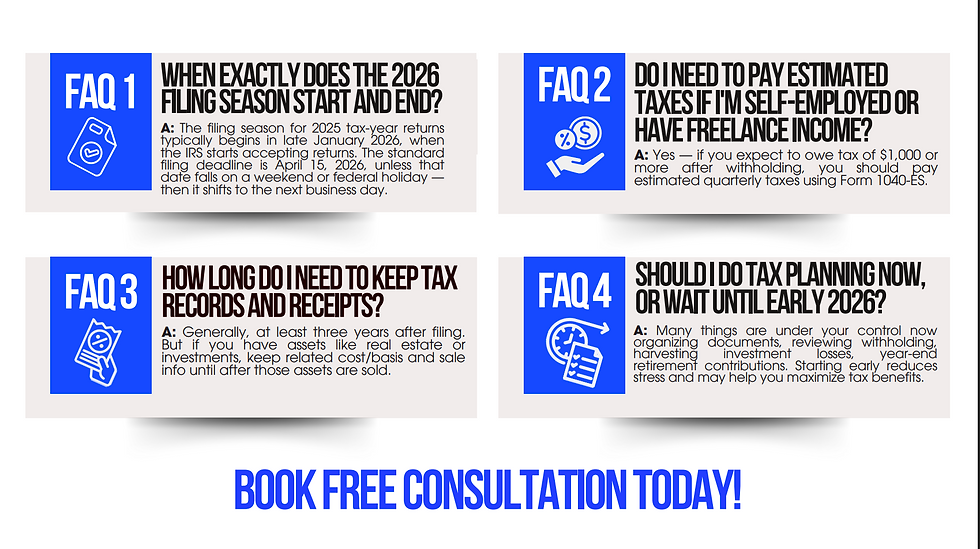
When we talk about the “2026 Tax Filing Season Preparation” we mean the period when you file your federal tax return in 2026 for the 2025 tax year. For most people, the standard deadline is April 15, 2026, unless it falls on a weekend or federal holiday — then it shifts to the next business day.
The federal tax agency Internal Revenue Service (IRS) typically begins accepting returns in late January. Because tax laws, inflation-adjusted limits, and IRS rules may change, treat this post as a preparation guide, not definitive advice — and verify with IRS resources when you file.
Why Star Early?
Waiting until spring to gather everything can cause delays, missing important credits, or scrambling at the last minute with incomplete info. Starting now helps you stay organized, catch potential tax planning opportunities (or pitfalls), and avoid errors or refund delays.
Top Steps to Get Ready for 2026 Tax Filing Season Preparation
Here are the most important actions you can take — ideally starting now:
Collect and Organize All your Tax Documents
Secure W-2s from employers, 1099s (NEC, MISC, INT, DIV), 1098s (mortgage interest, student loan interest), brokerage statements, K-1s, and SSA-1099 (Social Security).
Don’t forget receipts or records for charitable donations, medical bills, education expenses, home purchase/sale, and energy-efficient upgrades (if claiming credits).
Gather health-coverage forms (if covered under employer or marketplace plans) and any forms related to retirement contributions or distributions.
Set up a System to Store Documents
Create a dedicated folder (paper or digital) for 2025 tax-year documents — e.g., subfolders for income, expenses, investments, and receipts.
Scan paper receipts and PDFs from banks/investment accounts to avoid losing them.
If you use personal-finance or accounting software, export relevant reports and backups.
Review Withholding and Estimated Tax Needs
Use the IRS’s Tax Withholding Estimator (when updated for 2025) to check if your withholding is sufficient.
If you have freelance, gig, rental, or investment income — or are self-employed — consider making quarterly estimated payments using Form 1040-ES to avoid underpayment penalties.
If you’re an employee, you can submit a new Form W-4 to your employer to adjust withholdings.
Look at Retirement, Savings and Tax-Advantaged Accounts
Check if you can still make year-end contributions to IRAs, HSAs, 401(k)s — such moves can reduce taxable income (verify contribution limits).
If you’re considering a Roth conversion or other retirement strategy, note that such moves can have significant tax implications — consult a tax or financial advisor if needed.
Review any distributions from retirement accounts to ensure you have proper forms for 2025.
Review Investment Activity
Get brokerage statements that show cost basis, dividends, capital gains/losses. Confirm that cost basis reporting is correct.
Consider tax-loss harvesting — selling underperforming securities to realize losses that can offset gains (or reduce taxable income). This can be especially helpful if you had capital gains or expect large distributions.
Account for Life Changes
If you experienced any of these in 2025, make sure you have documentation:
Marriage, divorce, birth or adoption of a child.
Buying or selling a home.
Retirement, job change, job loss, new side business. These life events can affect filing status, deductions, credits, withholding, and more.
Check for Credits and Deductions You May Qualify For
Keep receipt or documentation for charitable donations, education expenses, energy-efficient home or vehicle upgrades, medical expenses, mortgage interest, etc.
Watch for credits like the Earned Income Tax Credit (EITC), Child Tax Credit, education credits, and any new or revived credits under recent law changes. (Because tax law may change, verify eligibility with current IRS guidance.)
Protect Your Identity and Tax Records
Store sensitive info (Social Security number, bank account and routing numbers) securely.
If eligible, consider applying for an Identity Protection PIN through the IRS.
Be alert for phishing scams — don’t click suspicious emails claiming to be the IRS.
Decide How You’ll File: E-file vs. Paper & Do-It-Yourself vs. Professional Help
E-filing (via approved software or a professional) with direct deposit is faster, more secure, and more accurate than mailing paper returns. The IRS has begun phasing out paper refund checks as of Sept. 2025.
Consider working with a tax professional if your situation is complex (investments, business income, property sale, major life changes, etc.) — or use high-quality DIY software if your return is straightforward.
Plan For Record Retention
Keep tax returns and supporting documents for at least three years. That covers the window when the IRS may audit.
If you have assets like real estate or stocks, keep records until after those assets are sold — cost basis and sale price can be important.
Monitor Changes To Tax Law or IRS Rules
For 2026 (tax year 2025), see recent IRS inflation adjustments and modifications under the law known as the One Big Beautiful Bill (OBBB) — such as adjusted credit and deduction limits.
Before filing, always check IRS.gov (or the equivalent authority) for updates to forms, thresholds, and instructions.
Schedule a “Tax-Prep Weekend”
Block out a weekend (or a few evenings) in January or February 2026 to gather everything, run withholding estimator if needed, and get ready — ideally before crowds and delays set in.
Sample Timeline: When to Take These Steps

FAQs: Common Questions Answered
What’s New for 2026 (Tax Year 2025) — What to Watch
Adjusted thresholds: Under the recent One Big Beautiful Bill (OBBB), some credits and deductions have changed. For example, the limit for health-flexible spending accounts, the foreign earned income exclusion, and transportation/parking benefits have been updated.
Phase-out of paper refund checks by the IRS — direct deposit is increasingly the default.
Because laws, thresholds and rules may change, always double-check on IRS.gov (or consult a tax professional) before filing.
Next Steps — What to Do This Week
Set up your 2025 tax documents folder (paper or digital).
Download or print last year’s 1040 and compare to what you expect for 2025 — note gaps.
If you haven’t looked at withholding recently, use the IRS Withholding Estimator early next year and act if there’s a big difference.
If self-employed or gig-working, mark estimated-tax payment due dates on your calendar, and plan for them now.
If your tax situation is complex (investments, business income, sale of home/property, retirement planning, major life change), consider reaching out to a qualified tax professional (CPA, EA, or enrolled agent). You can also sign up for our newsletter to get yearly prep reminders + bonus tips.
Ready to Get Ahead of the 2026 Filing Season? Let’s Make Your Prep Easy.
Preparing early isn’t just about staying organized — it’s about unlocking real tax savings and avoiding costly filing mistakes. With new inflation adjustments, updated credit limits, and changes rolling out for the 2025 tax year, staying proactive can make a big difference.
At RP Financial Services, LLC, we’ll help you get fully prepared for the 2026 tax season — from reviewing your documents and withholding to identifying credits, deductions, and planning opportunities tailored to your situation. Whether you’re an employee, retiree, gig worker, or investor, our team makes sure you file confidently and keep more of what you earn.

Navigating IRS interactions can feel overwhelming, but you don’t have to face it alone. At RP Financial Services, we guide you through every step—from understanding IRS communications to ensuring your compliance with tax laws.
Our experienced team provides personalized solutions for tax preparation, financial planning, and investment management — helping you make informed decisions with confidence and peace of mind.
With our commitment to excellence and attention to detail, we make your financial well-being our top priority. Whether you need assistance managing your taxes, planning for the future, or growing your wealth, we’re here to help you succeed.
📩 Contact us today at info@rpfs.llc or schedule your free tax consultation via our Calendly today to get a free 15-minute consultation for expert support and personalized solutions. Let us guide you toward financial clarity and success.


Comments